The Workshop
AI is changing what your clients pay for.
Two days from start to delivery: one on site with your senior team, then 2–3 offering briefs, specified and priced. Each names the first client to call, so you test before you build.
Book a conversationBuilt for law firms, accounting firms, marketing agencies, consulting firms, staffing firms, engineering firms, financial advisory firms, and architecture firms.
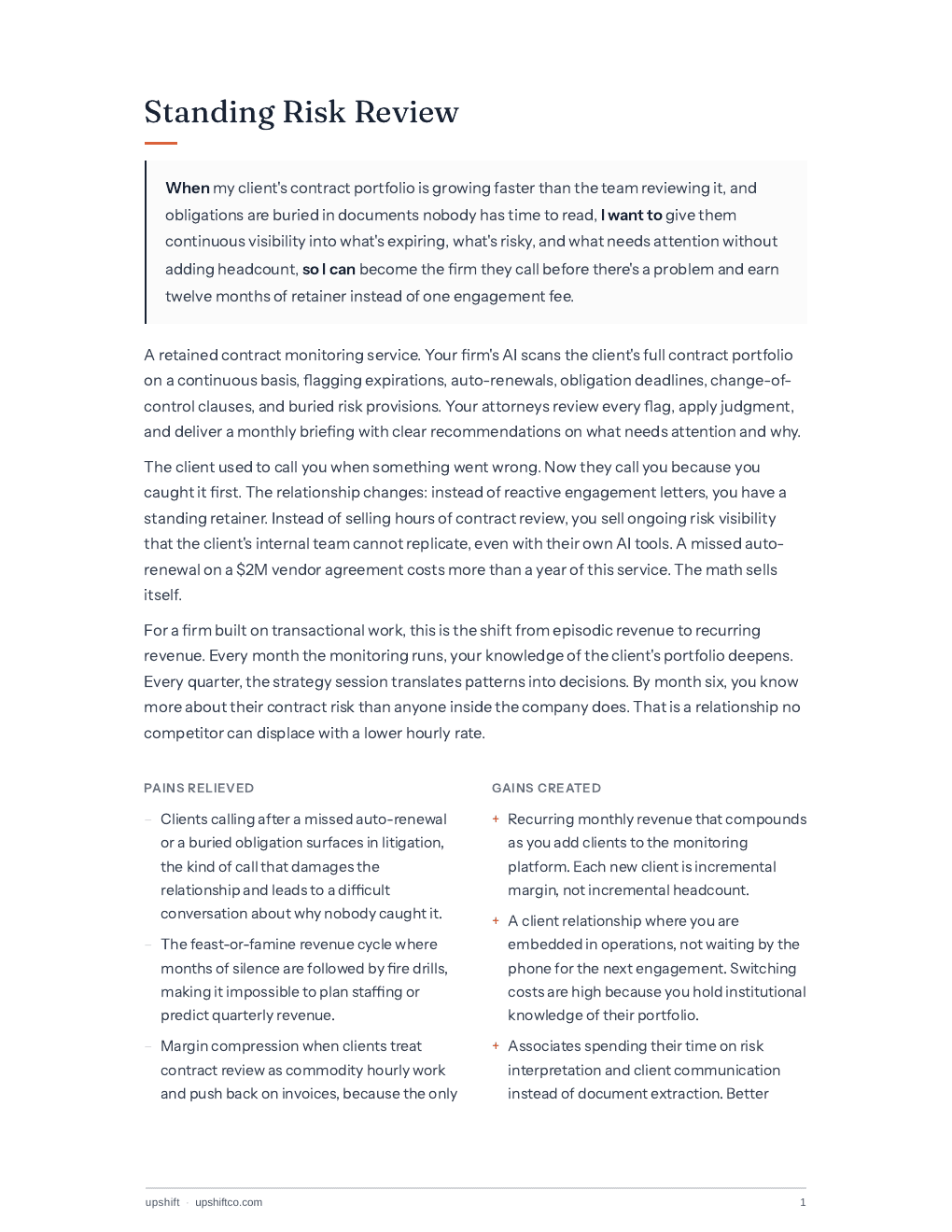
The same meeting, every quarter.
Your leadership team has had the AI conversation before. More than once. Probably at every meeting for the last year. Everyone agrees something needs to change. Nobody agrees on what first. And by the time anyone tries, the billable work that has to ship this week pulls the decision back into the drawer.
That’s not a strategy problem. It’s an incentive problem. The hours required to rebuild what the firm sells are the exact hours the compensation model punishes. Every partner makes a rational short-term decision and the firm makes a collective long-term mistake.
The partnership meeting is the wrong room for this conversation.
Different room. Different agenda. By the end of Day 2 you have three things a quarterly meeting hasn’t been able to produce: ratified offerings, named owners, and protected time on senior calendars.
Everything below explains how.
Built around decision-making, not technology.
An offering your clients will buy is the asset.
The Workshop uses proven frameworks from strategic facilitation, innovation design, and service economics, adapted for turning AI capability into new offerings.
The frameworks the Workshop applies are all public. The Three Shifts covers how firms move pricing from hours to outcomes, delivery from reactive to proactive, and the productization framework from bespoke to scalable.
The structure follows Kaner’s Diamond of Participatory Decision-Making. The divergent phase surfaces assumptions and maps territory your team hasn’t examined together. The convergent phase filters and scores. In between is what Kaner calls the “Groan Zone,” where different perspectives collide and easy answers fall apart. Most workshops skip past this. We don’t. That’s where your team’s assumptions about what’s possible get challenged by what AI actually makes feasible today.
Each session uses ORID (Objective, Reflective, Interpretive, Decisional), a question architecture developed by the Institute of Cultural Affairs. It prevents the conversation from jumping to solutions before the problem is understood. Objective: what’s actually true about the business. Reflective: what surprises or concerns the team. Interpretive: what patterns emerge. Decisional: what to do about it. The people in the room know things they don’t know they know. The right question sequence surfaces insight that a brainstorm never would.
Individual silent writing before any group discussion prevents the loudest voice from anchoring the conversation. It captures every senior person’s perspective, especially the quiet ones who often have the sharpest insight. Dot voting replaces open debate for prioritization, so decisions reflect collective judgment. The managing partner holds a formal Decider role: when the team is split, they make the call. This mirrors how decisions actually get made at the firm and ensures the output has executive commitment.
Day 1
In the room with your team
A full-day facilitated session with you and 3–6 senior people. The day has a deliberate arc: wide open to narrowed down.
Service Landscape Mapping
90 min
Your team walks through how the firm actually makes money. We map every service into three categories: what AI can automate, what AI can augment, and what stays human.
Opportunity Identification
90 min
For every AI-addressable task on the map: what new service becomes possible? What client segment opens up? What changes about pricing? We typically surface 8–15 opportunities.
Prioritization and Selection
60 min
Fifteen ideas aren’t useful. Two or three are. We filter on hard gates (describable to a real buyer, named person to test with, no legal risk), then score on commercial attractiveness and launch feasibility.
Rapid Specification
90 min
For each selected opportunity, six questions answered on the wall: What are we offering? Who buys it? How do we deliver? How do we price it? What’s our moat? Who’s the first client? Then a Pre-Mortem: “Imagine this failed. What went wrong?”
Seen enough?
Book a 30-minute conversationDay 2
Specification and handoff
Independent work. No client time until the closing call. I take the raw material from Day 1 and produce Offering Briefs: 2–3 pages each, specified enough to put in front of real buyers.
Each brief contains:
Service definition
Written the way a buyer would hear it. No internal jargon, no AI terminology.
Service blueprint
What the client sees, what your team does, what AI handles. Your team builds the delivery workflow from this.
Pricing structure
Specific price point or range, model rationale, and tiered options where appropriate.
Competitive positioning
Where the market is underserving buyers and how this offering fills the gap.
30-day launch plan
Who to call, what to say, and what to send. The first three moves.
The closing call walks through each brief with the managing partner and pressure-tests the key assumptions.
The first 30 days
In front of real buyers
The first 30 days after the closing call are part of the engagement. Your team runs the client conversations.
Three working sessions
across the month
We read what clients said and adjust the briefs. The time is on the calendar before billable work refills it.
Answers between sessions
as questions surface
A client asks something the briefs don’t cover. You send it, you get an answer, and the conversation keeps moving.
A longer runway, if you want it
after the month
If the month shows you need one, we scope it then: a working cadence until the first offering earns revenue.
Built to be tested, not filed.
The briefs aren’t a plan to come back to. Each one ends with the first three moves: the clients to approach, the language to use, what to send. They’re built to go in front of real buyers within days of the closing call, not to wait for next quarter.
That speed is deliberate. These offerings rarely fail on the idea. They fail in the weeks after the decision, when billable work refills the calendar and nobody comes back to the plan. A brief tight enough to test changes that. You put it in front of real buyers, cut what they don’t want, and build what’s left.
What this is not.
Not AI tool selection or implementation.
I don’t pick your software. The briefs specify what AI needs to do. Your team or an implementation partner handles the technology.
Not a training workshop.
Your team learns about AI capabilities during Day 1, but that’s a byproduct. You leave with new offerings, not certificates.
Not another strategy meeting.
Your partnership has already had several. The Workshop produces ratified decisions with named owners and protected time. That’s the difference.
Not a 100-page strategy document.
Three deliverables. Everything fits in a folder, not a binder.